What happened
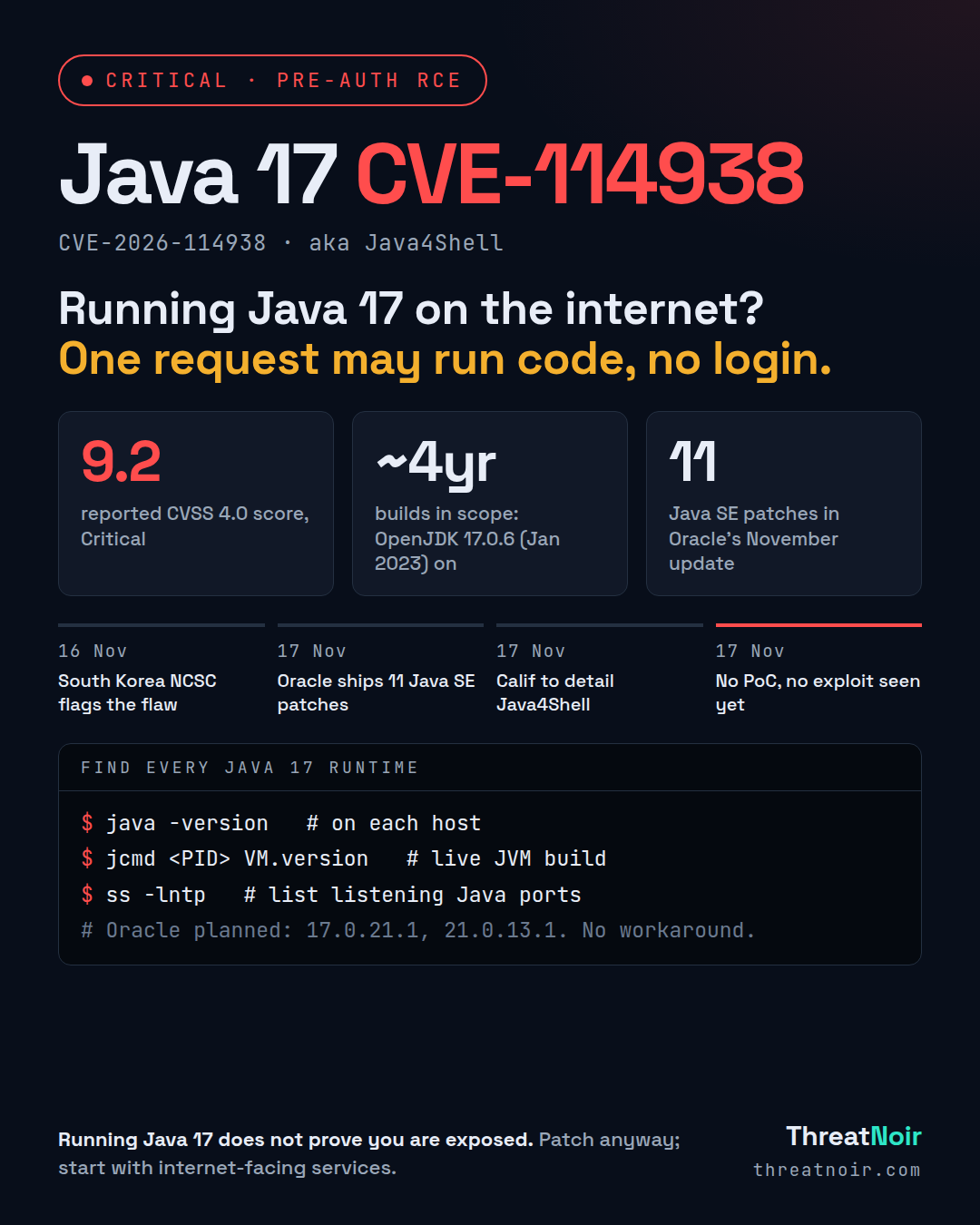
On 17 November 2026, public reports described CVE-2026-114938 as an unauthenticated remote code execution flaw in Java 17, caused by memory corruption. Early reports rate it 9.2 (Critical) under CVSS 4.0 and say it affects OpenJDK 17.0.6 and later. A security firm called Calif says it found and reported the flaw, which it calls Java4Shell, and that it planned to publish technical details at 1 p.m. Pacific on 17 November, after a patch shipped. watchTowr acknowledged the public reports but cautioned that details were unconfirmed.
The same day, Oracle's November 2026 Critical Security Patch Update shipped 11 Java SE patches. Oracle says all 11 may be exploited over a network without credentials. Its highest Java SE score this month is 8.1 under CVSS 3.1. Oracle has not tied any of the 11 fixes to CVE-2026-114938, and the CVE record was still reserved with no public description as of 17 November.
Treat the specifics as preliminary. What is solid: Oracle has pulled its current Java builds, and a reported pre-auth RCE in Java 17 is in the open.
Timeline
- 16 Nov: South Korea's NCSC flags an unauthenticated RCE in Java.
- 17 Nov: Oracle ships 11 Java SE patches, all remotely exploitable without auth.
- 17 Nov, 1 p.m. PT: Calif plans to publish Java4Shell details after the patch.
- 17 Nov: No proof-of-concept and no in-the-wild exploitation reported.
Am I affected?
You are in scope if you run any Java 17 build from OpenJDK 17.0.6 onward. That version shipped in January 2023, so the reported range covers almost four years of builds on one of Java's most widely deployed long-term support lines.
Oracle also lists these as affected by the November update: Java SE 8u511, 8u511-perf, 11.0.33, 17.0.21, 21.0.13, 25.0.5 and 27.0.1; GraalVM for JDK 17.0.21 and 21.0.13; GraalVM Enterprise Edition 21.3.20.0.3; and JavaFX 21.0.13, 25.0.5 and 27.0.1. Which of the 11 patches maps to which flaw will only be clear when Oracle's risk matrix is published.
Running Java does not by itself make a service exploitable. Oracle has not named the vulnerable component or the input path, so exposure depends on whether attacker-controlled data can reach the vulnerable code. Start with internet-facing services.
What to do now
- Inventory every Java runtime before details drop, not after. Run
java -versionon each host, and check the executable path of running Java processes, because many applications bundle their own JDK. - Check live JVMs where permitted with
jcmd <PID> VM.version, which reports the exact running build. - Check container base images in each Dockerfile and build pipeline so an old JDK is not reintroduced on the next deploy.
- Prioritise internet-facing Java services. List listening ports with
ss -lntpand close unneeded external exposure, including admin interfaces, with firewalls, security groups and IP allowlists. - Apply the vendor fix. Oracle JDK and GraalVM customers get fixes through the November update; Oracle's ops.java lists planned builds 8u513, 11.0.33.1, 17.0.21.1, 21.0.13.1, 25.0.5.1 and 27.0.1.1. If you run Temurin, Corretto, Zulu, the Microsoft or Red Hat builds, or a distribution package, wait for that vendor's fixed build, which may carry a different label.
- After updating, restart the Java processes and confirm the running build is the fixed one, not just the installed package.
How to hunt
Build a full list of Java runtimes, including those inside containers and bundled in apps. Rapid7 customers can use an authenticated vulnerability check in the 17 November content release (1.1.4115). Watch Oracle's advisory, the OpenJDK Vulnerability Group page and the CVE record for the fixed builds and the risk matrix that maps patches to CVEs.
What does not help
No workaround or configuration change has been published for CVE-2026-114938 by Oracle or any OpenJDK distributor. Patching is the fix. Firewalling and allowlisting reduce risk but do not replace the update. Do not assume you are safe because you run Java 17 and have not been attacked: for reference, the PHP2Shell flaws, also 9.2 under CVSS 4.0, were reported as exploited within a week of their 21 October patches.
Sources
- Pre-auth RCE flaw in Java 17 puts servers at risk: affected versions and how to fix (CVE-2026-114938), Aikido Security, 17 Nov
- Critical Java 17 RCE Vulnerability Puts Servers at Risk as Oracle Releases 11 Security Fixes, Cyber Security News, 17 Nov
- CVE-2026-114938: Reported Critical Pre-authentication Remote Code Execution in Java 17, Rapid7, 17 Nov
- CVE-2026-114938: Pre-Auth RCE Flaw in Java 17 Puts Servers at Risk, Cyber Kendra, 17 Nov
- Oracle to Patch 11 Java Flaws Today as Critical OpenJDK RCE (CVE-2026-114938) Report Emerges, The Hacker News, 17 Nov