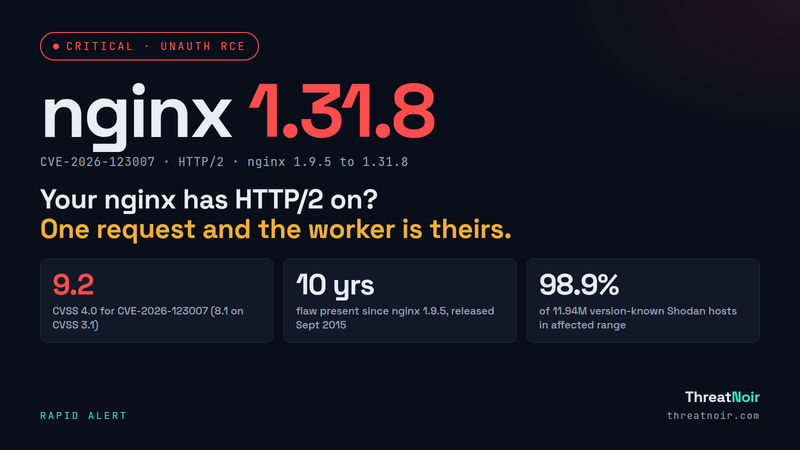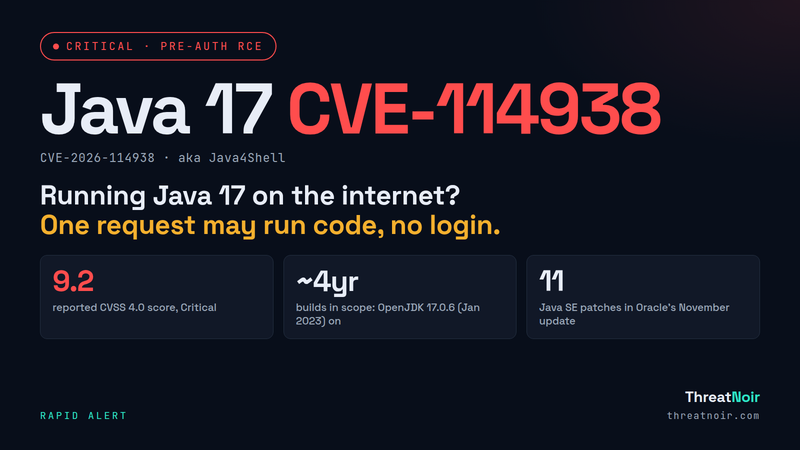
Since April, ThreatNoir has stored 138 stories with "2Shell" in the headline, and 122 of them arrived after the start of October. Several are the same flaw under different names, so that number measures noise as much as bugs. Still: PHP2Shell, Node2Shell, Java4Shell, Ruby2Shell, 33 flaws in N-able's remote management server, two in SAP. The question I kept coming back to is whether the answer is simply to be vigilant and patch within five minutes. I think that is the wrong race.
Why they all arrived at once
The name is only a label. Aikido traces the suffix to Log4Shell in 2021, and since React2Shell in December 2025 researchers put it on anything that goes from one request to running code. What the bugs share matters more. In Aikido's description every one of them sits below the application: in a language runtime, a framework, a compression decoder. A team can write careful code and still be exposed, because the vulnerable part is not something they wrote.
These are old bugs. The PHP flaws had been in the code since 2012, and a 2024 audit even surfaced one of them, but nobody could show it was exploitable. In August 2026, researchers at Calif and Wiz did, independently and with help from AI models. The Register reports that Calif says it spent about 200 dollars in tokens to find Java4Shell, a memory bug in Java's Base64 decoder that can be reached before login in default set-ups of Jira, Jenkins and Keycloak. One flaw in Google's Brotli decoder turned up in Node.js, .NET, Envoy and Python HTTP clients, and JFrog followed it into FFmpeg and ClickHouse.
So this is not a run of unrelated accidents. The cost of proving that a strange crash is a way in has collapsed, and the foundations everybody builds on are being read again, this time by machines.
The easy reading and the sharper one
The easy reading is that we must now patch faster. I understand the pull, and I will concede the part that is true: for an internet-facing service that can be attacked without a login, hours matter, and a rehearsed emergency lane is worth having.
But look at the PHP timeline. Amazon saw an exploitation attempt on 17 October. The patch shipped on 21 October. Attackers were four days ahead of the fix, not behind it. A sponsored analysis on BleepingComputer cites Verizon's figure of 43 days as the median time to fix a known exploited vulnerability, and Censys counting 32.5 million internet-facing PHP services still on potentially vulnerable versions on 27 October. On 19 November researchers at depthfirst demonstrated phpAfterShell, which gets code execution on servers that already have the October patches. Johannes Ullrich of SANS put it plainly on 18 November: you will not patch the next one across a large organisation before the exploit is out, so stop treating each of these as an emergency. They are the new normal.
The sharper take is that the race you can win starts after the shell. A shell gives the attacker whatever that server can read and reach. In the React2Shell campaign that Cisco Talos documented, one actor took 766 hosts in 24 hours and collected cloud tokens, SSH keys and the secrets sitting in environment variables. In the attacks Check Point described, the attacker came in through the Mobile Access portal of its gateways with PHP2Shell, used a second, new zero-day to become root, and in the first wave, against Israeli organisations, moved on to the VMware ESXi hosts and wiped them. Both began with one unauthenticated request. The damage was decided by what the compromised machine was allowed to touch.
What I would put in front of a board
Four boring things, each with an owner.
Know what you run, including what you did not install. PHP ships inside appliances and hosting panels, and Brotli is compiled into runtimes and proxies. If it takes a week to answer where you have a component, the speed of your patch lane does not matter.
Take things off the internet. Admin portals and self-hosted tools such as GitLab or Jenkins belong behind a VPN or an identity proxy. Ullrich's version is shorter: this should have been a priority years ago.
Decide what a web server may reach. No outbound internet by default, no long-lived cloud keys in config files, no route from a gateway to the hypervisors. This is the work that does not depend on winning a race, and it can be measured, which makes it a fair entry in a risk register: for each exposed service, what can it read, and who signed that off. I should be honest that none of the reporting gives a number for how often these controls stopped one of these intrusions. I am arguing from how the attacks went, not from a measured result.
Keep two patch lanes. An emergency lane measured in hours for what is exposed and needs no login, automated patching for the systems at the bottom of the list, and a normal pace for the rest, so the team is still standing for the next one. For an appliance you cannot patch yourself, ask the vendor now how long its own fix takes. And when you patch, look back to the first known exploitation date, not to the day you patched.
Anthropic's deputy CISO told security leaders in October to go to their boards and ask for help, not for AI but for the basics. I agree, with one addition.
The question is no longer how fast you patch. It is how little a shell is worth on your network.
Sources
This article rests on reporting by several publishers. ThreatNoir's own count of headlines is from its stored stories on 19 November 2026.
- Aikido Security, 2026-10-29: What are shell vulnerabilities? PHP2Shell, Node2Shell (HTTP2Shell), React2Shell and Log4Shell explained
- Aikido Security, 2026-10-29: Ghost in the PHP2Shell: Why coordinated disclosure and patching will start moving faster
- Aikido Security, 2026-10-29: The day after tomorrow: After PHP2Shell, it gets worse, then defenders win
- BleepingComputer (sponsored by Token Security), 2026-10-28: Even after PHP2Shell, blast radius matters more than a CVSS score
- The Register Security, 2026-11-18: Oracle reveals fix-this-ASAP-grade Java4Shell bug that allows attacks on many third-party apps
- SANS Internet Storm Center, 2026-11-18: Java4Shell, NGINX2Shell and more: Why we are not at "Yellow", (Wed, Nov 18th)
- Hackread, 2026-10-21: PHP Releases Emergency Fixes for Critical PHP2Shell Vulnerabilities
- Tenable Research, 2026-10-27: Brotli2Shell: Frequently asked questions for Google Brotli decoder vulnerability (CVE-2026-111497)
- Aikido Security, 2026-11-19: Ruby2Shell: critical Ruby RCE, affected versions and how to fix it (GHSA-34m4-m9fh-gqp5)
- Cyber Kendra, 2026-11-10: Able2Shell: 33 N-able N-central Zero-Days Under Attack
- BleepingComputer, 2026-11-13: Check Point gateways hacked via PHP2Shell to deploy VMware ESXi wiper
- Cyber Security News, 2026-11-19: New phpAfterShell Attack Bypasses PHP2Shell Fix to Enable Remote Code Execution
- SecurityWeek, 2026-04-03: React2Shell Exploited in Large-Scale Credential Harvesting Campaign
- BleepingComputer, 2026-11-10: SAP patches ICM2SHELL and PROXYGATE maximum severity flaws
Related on ThreatNoir
- Insignary Releases Free Insignary-Chk Tool to Detect PHP2Shell and Node2Shell Exposure, Cyber Security News
- PHP2Shell and Node2Shell: Find, Fix, and Verify Across Your Web Apps and APIs, Qualys Threat Research
- Hackers Exploit PHP2Shell Flaws in Check Point Gateways to Deploy TSGA Backdoor and Wipe ESXi Files, The Hacker News
- PHP2Shell Exploited in Destructive Check Point Gateway Attacks, SecurityWeek
- CIS Controls Control 7: Continuous Vulnerability Management
- CIS Controls Control 4: Secure Configuration of Enterprise Assets and Software
- NIST CSF PR.IP-12: Information Protection Processes and Procedures (CSF 1.1)
- NIS2 Article 21(2)(e): Security in acquisition, development and maintenance (Article 21(2)(e))
- ISO 27001 Annex A 8.8: ISO/IEC 27001:2022 Annex A 8.8: Management of technical vulnerabilities