What happened
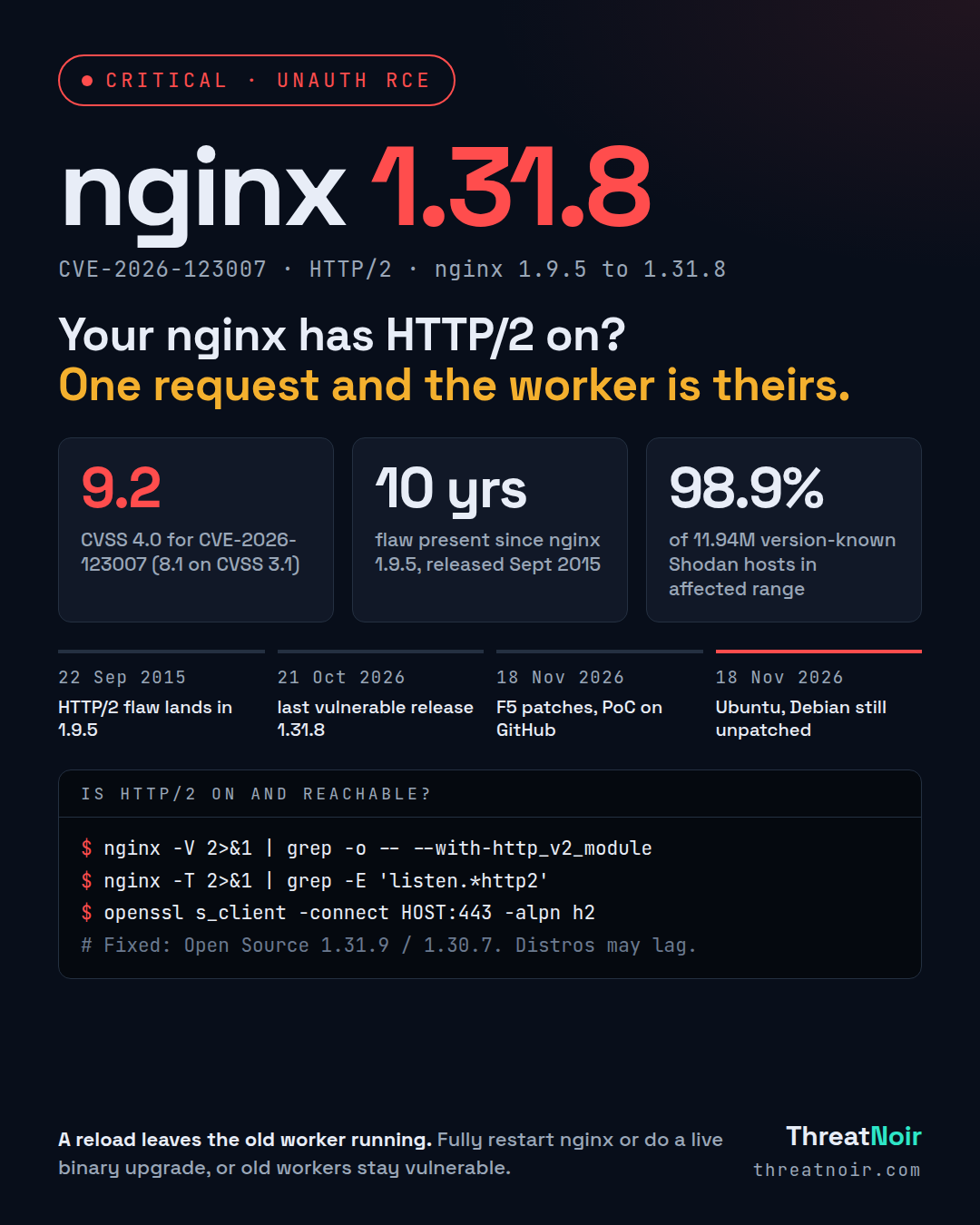
On 18 November 2026, F5 shipped out-of-band fixes for ten CVEs in open-source nginx. Five of them, named nginx2root by researchers at Xint, each allow an unauthenticated attacker to run code with the privileges of an nginx worker process. The lead flaw, CVE-2026-123007, is an integer underflow in nginx's HTTP/2 flow-control code that leads to an out-of-bounds memory copy. F5 scores it 9.2 on CVSS 4.0 (8.1 on CVSS 3.1).
The bug has been in every official release since 1.9.5, the September 2015 version that introduced HTTP/2. Running code this way gets the worker's permissions. Getting root on the host needs a second step: in Xint's tests, a worker reached root through a separate use-after-free in the Linux kernel's SCTP code, even from inside a Docker container. That kernel bug has no CVE and no patch yet.
Researchers at Wiz, Rapid7, Ikotas Labs, Metnir and Xint found the HTTP/2 flaws independently, most with AI assistance. F5, Wiz and Rapid7 report no attacks in the wild so far, and CISA's KEV catalogue did not list it as of 18 Nov. A proof-of-concept is on GitHub, but its notes say it suits only demonstrating against a freshly started Docker container on the same machine.
Timeline
- 22 Sep 2015: HTTP/2 flaw introduced in nginx 1.9.5.
- 21 Oct 2026: last vulnerable release, 1.31.8.
- 18 Nov 2026: F5 releases 1.31.9 and 1.30.7; nginx2root disclosed; PoC published.
- 18 Nov 2026: Ubuntu and Debian list nginx as vulnerable, no fixed packages yet.
Am I affected?
A system is in scope for CVE-2026-123007 only when both are true:
- The build is unpatched: nginx Open Source 1.9.5 through 1.31.8, or affected nginx Plus (37.0.0 before 37.0.8.1, 37.1.0 before 37.3.0.1, and R33 and later R-series). R34 to R36 have no fix listed.
- HTTP/2 is turned on for at least one listener, and an attacker can open an HTTP/2 connection to nginx itself.
The other four flaws each need a different setup: CVE-2026-123633 (HTTP/2 to a backend with low worker_connections), CVE-2026-123634 (resolver with SSI or mirror), CVE-2026-121810 (HTTP/3 on) and CVE-2026-113425 (mail proxy). All five are fixed by 1.31.9 and 1.30.7.
Forks including OpenResty, Tengine, Angie and freenginx still carry the vulnerable code. The archived community ingress-nginx bundles nginx 1.27.1 with HTTP/2 on by default and will get no fix.
What to do now
- Confirm the build includes HTTP/2:
nginx -V 2>&1 | grep -o -- --with-http_v2_module. - Confirm the config turns it on:
nginx -T 2>&1 | grep -nE 'listen.*http2|http2 +on'. - Test from outside:
openssl s_client -connect HOST:443 -servername HOST -alpn h2 </dev/null.ALPN protocol: h2means it accepts HTTP/2. Behind a CDN, test the origin directly. - Upgrade to 1.31.9 (mainline) or 1.30.7 (stable). On nginx Plus use 37.3.0.1 or 37.0.8.1. Do not trust
nginx -valone on distro builds: compare the full package version with the distribution's advisory. - After upgrading, fully restart nginx or do a live binary upgrade. A reload leaves the old executable and old workers running.
- If you cannot patch yet, turn off HTTP/2: on 1.25.1 and later set
http2 off;and removehttp2from listen lines; on 1.9.5 to 1.25.0 changelisten 443 ssl http2;tolisten 443 ssl;. Rerun the openssl check. This closes only the two HTTP/2 flaws. - On hosts not using SCTP, block the kernel module: add
install sctp /bin/falseto a .conf file in /etc/modprobe.d/. This does not unload an already loaded module.
How to hunt
CIRCL suggests looking for nginx workers that start unexpected programs, workers that exit abnormally or leave core dumps, long-lived HTTP/2 connections with heavy incoming traffic but few logged requests, and unusual outbound connections or DNS lookups. A clean access log does not rule out an attack: HTTP/2 control frames do not normally appear there as requests. None of these signs is proof on its own.
What does not help
Turning off HTTP/2 does not stop CVE-2026-123634, CVE-2026-121810 or CVE-2026-113425. For the resolver flaw, avoid SSI and mirror directives and do not build a proxied server name from variables. For the mail proxy flaw, limit listeners to trusted networks. Internet exposure should order your work, not close findings: an internal nginx with HTTP/2 on is still reachable by anyone already inside the network.
Sources
- 10-Year-Old NGINX HTTP/2 Flaw Lets Unauthenticated Attackers Execute Code on Servers, The Hacker News, 18 Nov
- NGINX2Root: Five nginx Flaws, Led by CVE-2026-123007. How to Find, Mitigate, and Patch Now, Qualys Threat Research, 18 Nov
- nginx2root: NGINX HTTP/2 RCE Flaws (CVE-2026-123007) Patched, Cyber Kendra, 18 Nov
- AI found more critical bugs in another widely used technology running 225M websites, The Register Security, 18 Nov
- It’s NGINX’s turn to cause vulnpocalypse headaches, CyberScoop, 18 Nov