What happened
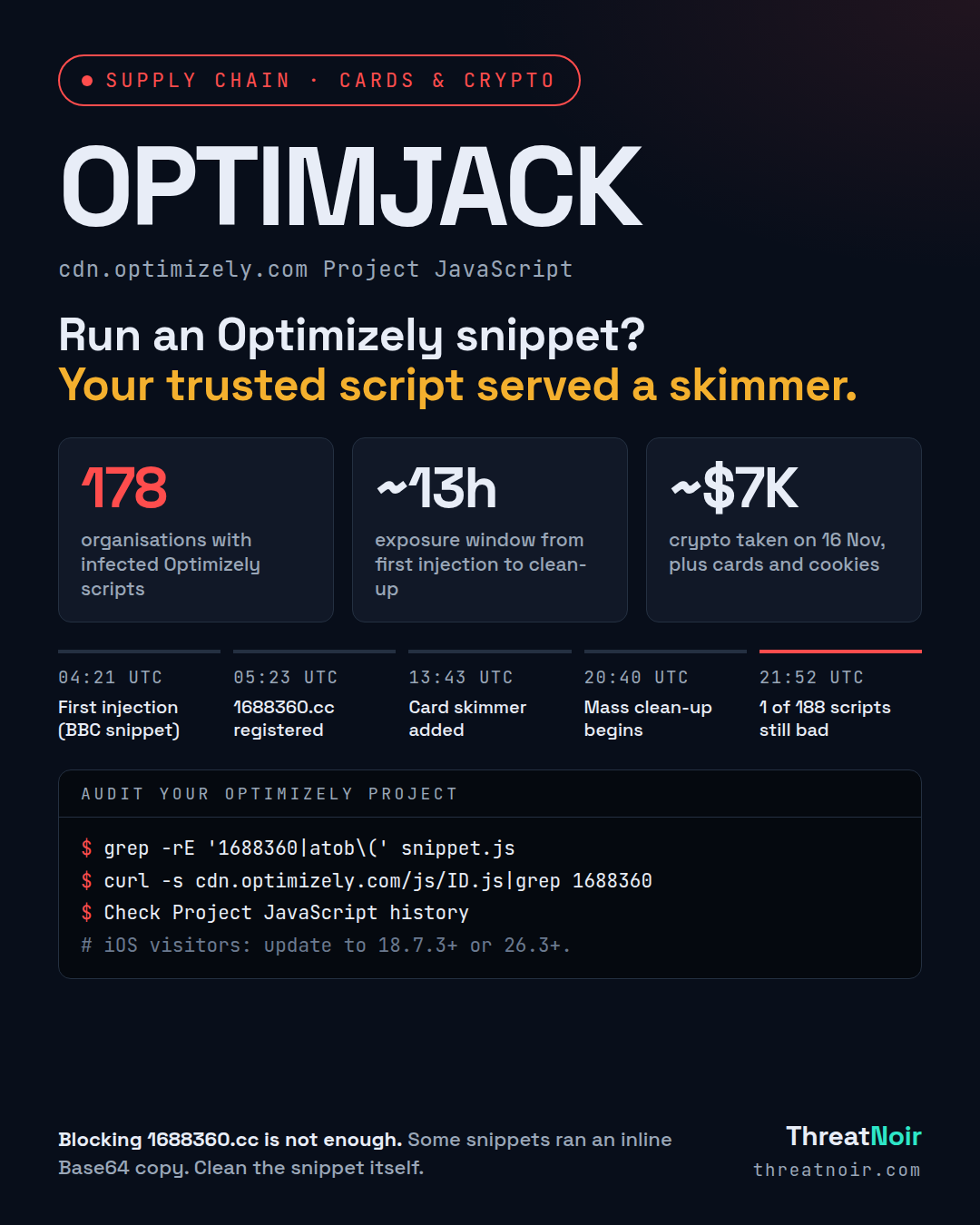
On 16 November 2026 attackers abused Optimizely Web, an A/B testing and experimentation platform. Each customer loads a single JavaScript snippet from cdn.optimizely.com, which includes an optional field called Project JavaScript that runs on every page. The attacker wrote a short loader into that field across many unrelated customer projects and left the rest of each snippet untouched.
The loader added a script tag pointing to 1688360[.]cc/track.js, the attacker's server. Because the file was still served from Optimizely's own domain with a valid Optimizely certificate, browsers and most allowlists treated it as legitimate. Report URI ruled out CDN cache poisoning: the CDN served exactly what the platform provided, which points to write access inside the platform itself, either a compromised system or a credential with cross-customer access.
Scott Helme of Report URI found the campaign after checking 1,611 Optimizely scripts and finding 188 infected, belonging to 178 organisations. Independent researcher Amirul Cyber named it OPTIMJACK. Optimizely's own snippets, including login.optimizely.com, also carried the code.
The track.js payload is one file of about 30 KB with three parts: a crypto address swapper, a card skimmer, and an iOS exploit-delivery branch. It also sent page URLs, readable cookies and screenshots to 1688360[.]cc/hit.php.
Timeline
All times UTC on 16 November unless stated.
- 04:21: First Optimizely injection found, in the BBC's snippet, two hours after the last clean capture.
- 05:23: Attacker registered 1688360[.]cc.
- 08:10: First track.js build.
- 13:43: Card skimmer added.
- 17:56: Final payload version went live (about 30,430 bytes).
- 20:40 to 21:10: Mass clean-up, infected scripts fell from 169 to a handful.
- 21:52: Only one of the 188 scripts, belonging to TalkTalk, still infected.
Report URI recorded 26 payload rebuilds during the day. The exposure window was at least about 13 hours.
Am I affected?
You are affected if your site loads an Optimizely Web snippet, whether from cdn.optimizely.com or served from your own domain (the content still came from the Optimizely project). Sites named across the reports include Zoom, CNN, BBC, Fox News, Salesforce, GitLab, IKEA, HSBC, Equifax, Air France-KLM, Ledger, Peacock, ASOS, Levi's and many more. Banking and finance was the largest group with 32 organisations.
Appearing on a list means your Optimizely script was infected, not that your own servers were breached. Helme says the true total is probably higher than 178, because 1,611 scripts is not every Optimizely customer. Optimizely was cleaning files on the evening of 16 November, so a clean result now does not prove the file was clean earlier.
An earlier wave from 13 to 16 November used the same actor's injector from webshell[.]lol served through Kissmetrics, StorifyMe and Minute Media's scripts.
What to do now
- Open every Project JavaScript field and every experiment's custom code. Search for 1688360, atob( and any script you did not write.
- Use Optimizely's change history. It logs all Project JavaScript changes and shows whether each came via the REST API or the web interface.
- Review users, API tokens and integrations, then rotate those credentials.
- Block 1688360[.]cc and the .icu hosts in the IOC table, but do not stop there (see below).
- Treat cards entered on 16 November and any secrets in non-HttpOnly cookies as exposed. HttpOnly cookies were out of the script's reach.
- Tell iOS visitors to update to iOS 18.7.3 or later, or 26.3 or later. Older versions were offered the Coruna (iOS 13 to 17) or DarkSword (iOS 18) exploit kits. No one has shown an iPhone was actually compromised.
How to hunt
- Check for outbound requests to 1688360[.]cc and the .icu hosts in your web and DNS logs for 16 November.
- Look for the final payload by SHA-256 f7b84b9a94f749f8ced3f0112d0a66894e8bbc3b4aa5592021d1b8976a9bad40.
- Fetch your live snippet and inspect it as text. Do not run it. Search for 1688360, track.js, card.php, hit.php and atob(.
- Note that Smartsheet was cleaned then re-infected with the Base64 variant, so re-check more than once.
What does not help
Blocking 1688360[.]cc alone does not stop it. Hudson Rock recovered BBC and HSBC UAE scripts with an identical 24,392-byte Base64 payload that runs if the remote download fails or takes longer than 2.5 seconds. You must clean the snippet itself.
Content Security Policy helped. Of affected organisations Report URI checked, 68 had no CSP and only 24 blocked the payload. Allowing unsafe-eval or strict-dynamic let the code through.
Sources
- OPTIMJACK: Optimizely-Hosted Scripts Loaded a Crypto Clipper and Card Skimmer on 186 Confirmed Sites, StepSecurity, 16 Nov
- Optimizely Malware Hits Zoom, BBC, CNN: What to Do, Cyber Kendra, 17 Nov
- Hackers Infect 178 Major Websites via Optimizely to Steal Credit Cards and Target iPhones, Cyber Security News, 17 Nov
- Optimizely supply chain attack infects major brands' sites with malware, BleepingComputer, 17 Nov